Recent technology and cybersecurity incidents involving JPMorgan Chase and other major U.S. financial institutions provide an important reminder that even the largest and most sophisticated banks remain vulnerable to third-party security failures, technology disruptions, and operational weaknesses.
Two separate incidents involving JPMorgan Chase have attracted particular attention.
The first involved a cyberattack targeting third-party service providers that potentially exposed customer information. The second involved widespread banking service disruptions attributed to a software defect in JPMorgan Chase's on-premises hardware systems.
Although the bank has emphasized that these incidents were unrelated, together they illustrate an important challenge facing financial institutions of every size: maintaining operational resilience in an increasingly interconnected technology environment.
For community banks, the incidents also provide an opportunity to evaluate whether their existing vendor management, cybersecurity, change management, and business continuity programs adequately address these risks.
Third-Party Cyberattack Potentially Exposes Customer Information
On November 19, 2026, JPMorgan Chase disclosed that hackers had targeted third-party companies providing services to the bank.
According to the bank, its preliminary investigation indicated that attackers accessed certain marketing information maintained by outside vendors. The information potentially included customer names and email addresses.
The disclosure followed claims by a cyber-extortion group identifying itself as "n0n," which published information allegedly obtained through attacks involving third-party service providers.
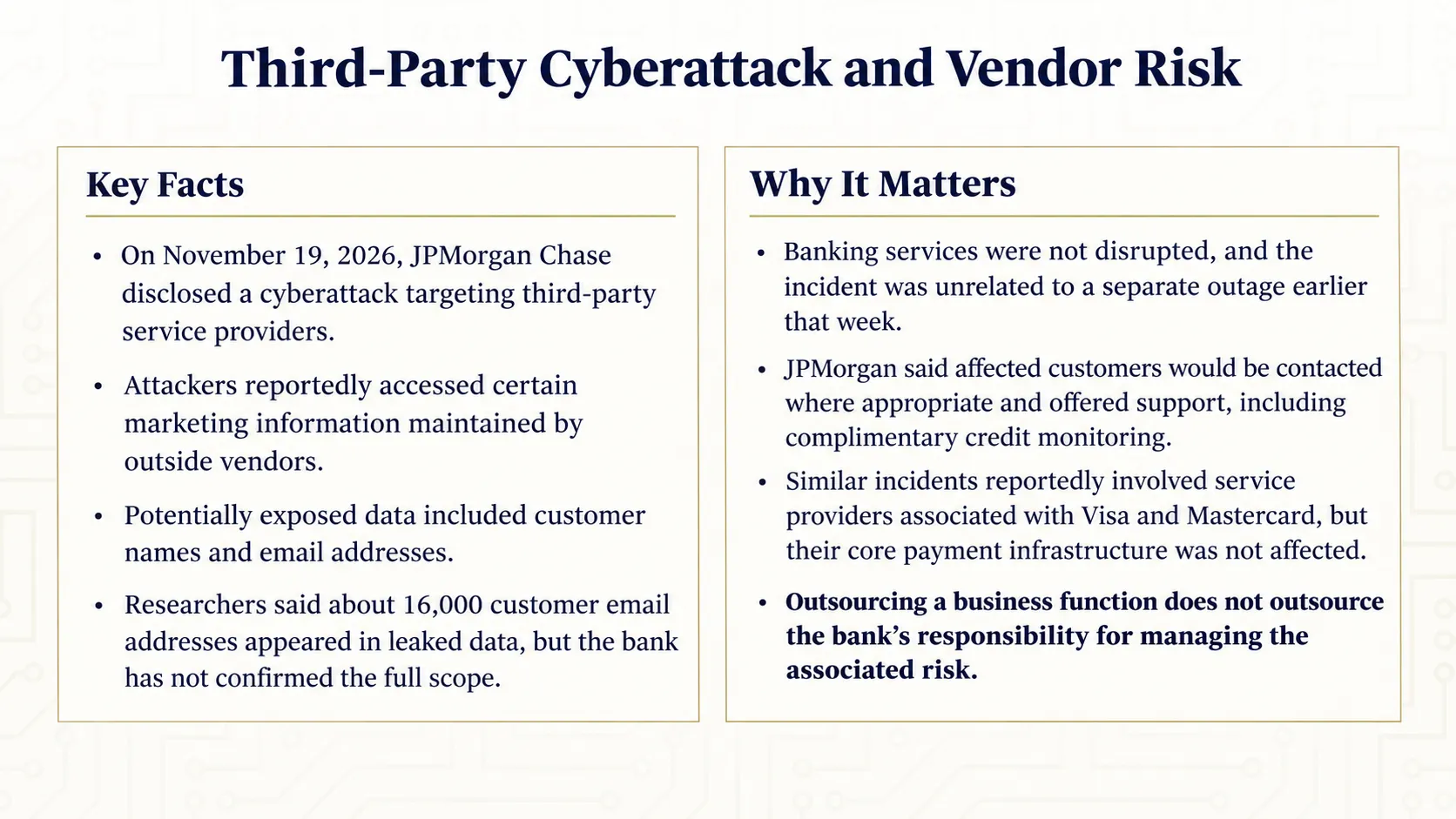
Cybersecurity researchers reported that approximately 16,000 JPMorgan Chase customer email addresses appeared in the leaked information, along with some telephone numbers and employee email addresses. However, the bank has not independently confirmed the reported number of affected customers or the full scope of the information involved.
JPMorgan Chase stated that the incident did not disrupt banking services and was unrelated to the separate service outage experienced earlier in the week. The bank indicated that affected customers would be contacted where appropriate and offered support, including complimentary credit monitoring.
Similar incidents reportedly involved service providers associated with Visa and Mastercard. Both payment companies indicated that their core payment infrastructure was not affected.
The incident illustrates an increasingly important cybersecurity concern: financial institutions can experience data exposure even when their own networks and internal systems have not been directly compromised.
The regulatory significance is straightforward: outsourcing a business function does not outsource the bank's responsibility for managing the associated risk.
Why This Matters to Community Banks
Community banks frequently rely on outside service providers for critical and noncritical functions, including:
- Core banking and digital banking platforms.
- Online account opening and loan origination.
- Marketing automation and customer relationship management.
- Payment processing and electronic funds transfers.
- Cloud hosting and data storage.
- Customer communications and document management.
- Managed security services and IT support.
These providers may have access to customer information, employee information, authentication credentials, or other sensitive bank data.
The JPMorgan incident reinforces the importance of understanding exactly what information vendors possess, why they possess it, where it is stored, and which subcontractors may have access to it.
A vendor that performs a seemingly routine marketing or customer engagement function may still introduce meaningful cybersecurity and reputational risk.
Banks should not limit third-party cybersecurity assessments to vendors classified as critical or mission essential. The sensitivity of the information being accessed or maintained should also influence the level of oversight.
Banking Service Outages Highlight Technology and Change Management Risks
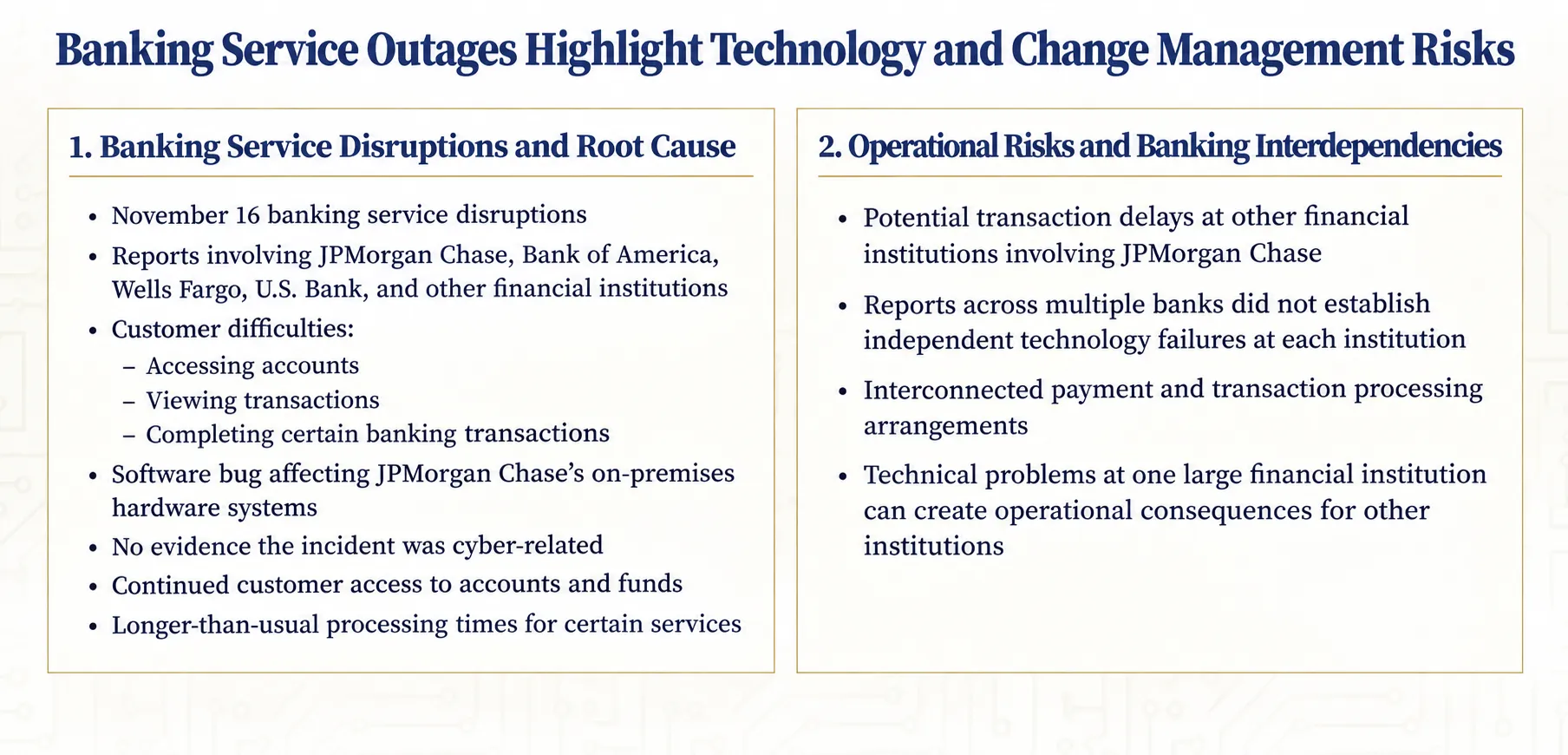
Just days before the vendor cyberattack became public, JPMorgan Chase and several other financial institutions experienced banking service disruptions.
On November 16, customers reported difficulties accessing accounts, viewing transactions, and completing certain banking transactions.
The disruptions generated reports involving JPMorgan Chase, Bank of America, Wells Fargo, U.S. Bank, and other financial institutions.
JPMorgan Chase subsequently attributed its problems to a software bug affecting its on-premises hardware systems.
The bank stated that there was no evidence the incident was cyber-related and explained that other financial institutions could have experienced transaction delays when JPMorgan Chase was involved in the underlying transactions.
The bank also indicated that customers continued to have access to their accounts and funds, although certain services were taking longer than usual.
The distinction is important. Reports of service problems across multiple banks did not establish that every institution experienced an independent technology failure.
The incident nevertheless demonstrates how a technical problem at one large financial institution can create operational consequences for other institutions through interconnected payment and transaction processing arrangements.
Treasury Secretary Comments on Banking Resilience
On November 22, Treasury Secretary Scott Bessent addressed the recent technology disruptions during an appearance on CBS's Face the Nation.
Bessent emphasized that financial institutions have invested heavily in cybersecurity for decades and described banks as among the most resilient companies in the U.S. economy.
He compared the temporary disruptions associated with security updates to the side effects of a vaccine, suggesting that short-term inconveniences can accompany improvements in long-term protection.
His comments raise an important point for financial institutions.
Security patches, infrastructure upgrades, software updates, and technology modernization are necessary components of an effective cybersecurity program. However, these activities must be implemented through controlled processes that consider availability, operational dependencies, testing, rollback procedures, and customer impact.
Improving cybersecurity should not come at the expense of operational resilience.
Banks must demonstrate that technology changes are appropriately evaluated, tested, approved, implemented, and monitored.
What Should Banks Be Evaluating?
These incidents provide a useful framework for evaluating several areas of an institution's existing risk management program.
1. Third-Party Risk Management
Banks should evaluate whether their vendor management programs adequately address cybersecurity risks involving service providers and subcontractors.
Examiners will generally expect institutions to demonstrate an appropriate risk-based approach to identifying, assessing, monitoring, and managing third-party relationships.
Consider the following questions:
- Does the bank maintain an accurate inventory of third-party service providers?
- Does the bank understand what customer and confidential information each vendor can access?
- Are vendors required to maintain appropriate information security controls?
- Does the bank obtain and review SOC 1 and SOC 2 reports, where applicable?
- Are vendor cybersecurity incidents required to be reported promptly?
- Does the bank understand the security controls maintained by vendor subcontractors?
- Are vendors required to notify the bank of material security incidents affecting bank information?
- Are data retention, encryption, access restrictions, and secure destruction requirements addressed contractually?
- Does the bank periodically reassess vendors based on changes in services, technology, or risk?
An especially important consideration is whether the bank's vendor inventory accurately identifies providers that have access to sensitive customer information but are not necessarily classified as critical vendors.
2. Data Classification and Information Access
The JPMorgan incident also highlights the importance of knowing where customer information resides outside the bank's immediate technology environment.
Banks should evaluate whether their data classification programs identify sensitive information and establish appropriate requirements for its use, transmission, storage, and disclosure.
A useful exercise is to identify all third parties that receive or maintain:
- Customer names and contact information.
- Account information.
- Loan and deposit information.
- Social Security numbers and other personally identifiable information.
- Authentication information and security credentials.
- Confidential employee and business information.
The bank should also consider whether vendors receive more information than necessary to perform their contracted services.
Data minimization is an important security control. Information that is never provided to a vendor cannot be exposed through that vendor's systems.
3. Change Management and Configuration Management
The November 16 banking disruption reinforces the importance of formal change management.
Banks should have documented processes addressing:
- Identification and authorization of technology changes.
- Risk assessments before implementation.
- Testing in appropriate environments.
- Management approval for significant changes.
- Evaluation of potential downstream system impacts.
- Backout and recovery procedures.
- Post-implementation monitoring.
- Documentation of unexpected results and corrective actions.
These requirements should extend beyond internally developed systems.
Banks must understand how their service providers manage material software updates, infrastructure changes, security patches, and configuration modifications.
A vendor's SOC report may provide some insight into its change management controls, but banks should not assume that a SOC report eliminates the need for ongoing oversight.
4. Business Continuity and Disaster Recovery
The banking disruptions also demonstrate why business continuity planning must account for dependencies outside the institution's direct control.
Community banks should evaluate whether their business continuity plans adequately address:
- Core banking system unavailability.
- Digital banking disruptions.
- Payment processing interruptions.
- ACH and wire transfer delays.
- Third-party service provider outages.
- Authentication and identity management failures.
- Telecommunications and connectivity disruptions.
- Extended outages involving critical technology providers.
Importantly, banks should consider whether they can continue essential operations when a major service provider is unavailable.
A business continuity plan that assumes a vendor will always be available is not an effective contingency strategy.
5. Incident Response and Customer Communications
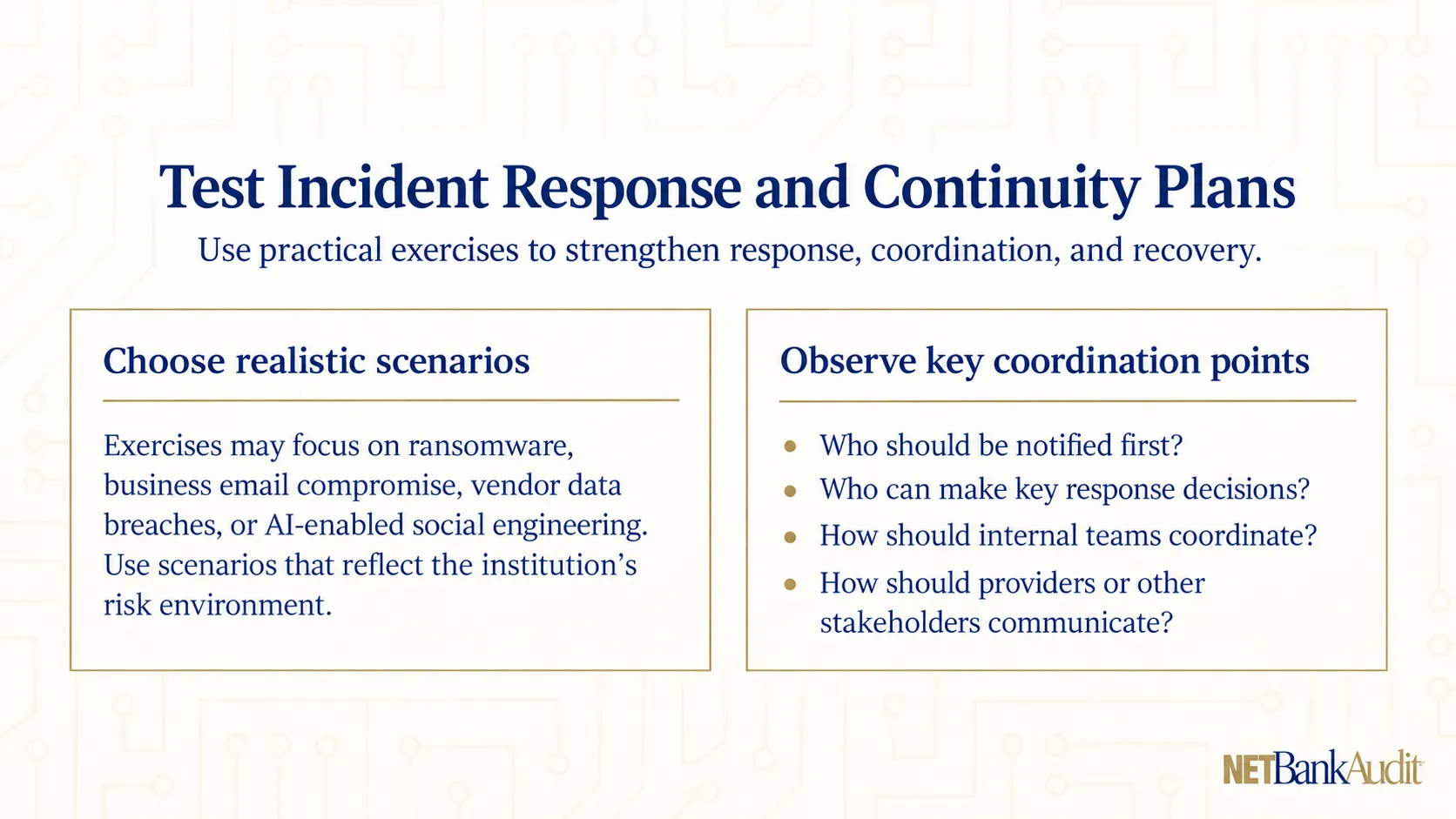
Another important consideration is how quickly a financial institution can identify, assess, escalate, and communicate a technology or cybersecurity incident.
Banks should evaluate whether their incident response programs clearly establish:
- Internal escalation requirements.
- Management and board notification thresholds.
- Vendor notification requirements.
- Regulatory reporting responsibilities.
- Customer notification procedures.
- Coordination with law enforcement and appropriate government agencies.
- Documentation of incident response activities.
The distinction between a cybersecurity incident and an operational technology failure is important, but both can create regulatory, reputational, and customer service consequences.
Regulatory and Examination Considerations
The recent incidents are consistent with several longstanding supervisory expectations for financial institutions.
Federal banking agencies have repeatedly emphasized the importance of effective third-party risk management, information security, business continuity, and operational resilience.
The following guidance remains particularly relevant.
Interagency Guidance on Third-Party Relationships: Risk Management (June 2023)
The interagency guidance issued by the Federal Reserve, FDIC, and OCC establishes expectations for managing third-party relationships throughout their lifecycle.
This includes planning, due diligence, contract negotiation, ongoing monitoring, and termination.
The JPMorgan incident reinforces the importance of evaluating vendor cybersecurity controls, understanding subcontractor relationships, and maintaining appropriate oversight of information entrusted to third parties.
FFIEC Information Security Booklet
The FFIEC Information Security guidance addresses information security governance, risk management, security operations, access controls, and incident response.
Banks should be able to demonstrate that their information security programs address risks associated with external service providers and the protection of sensitive information.
FFIEC Business Continuity Management Booklet
Business continuity management expectations extend beyond traditional disaster recovery.
Institutions should identify critical business functions, understand dependencies, establish recovery strategies, and periodically test their ability to continue operations during disruptive events.
Computer-Security Incident Notification Requirements (2022)
The federal banking agencies' computer-security incident notification rule requires banking organizations to notify their primary federal regulator as soon as possible and no later than 36 hours after determining that a notification incident has occurred.
Separately, qualifying bank service providers must notify affected banking organization customers as soon as possible when they determine that an incident has materially disrupted or degraded covered services for four or more hours.
Banks should understand these requirements and ensure that vendor contracts and incident response procedures support timely notification and regulatory escalation.
What Examiners May Ask
While individual examination procedures will depend on the institution and its risk profile, these incidents provide a reasonable basis for expecting examiners to explore questions such as:
- How does management identify and assess cybersecurity risks associated with third-party service providers?
- Can the bank identify all vendors that have access to sensitive customer information?
- How does the institution evaluate subcontractor and supply-chain risks?
- Does the bank receive timely notification of cybersecurity incidents involving its service providers?
- How are material software changes and security patches evaluated, tested, and approved?
- Does the bank have documented procedures for responding to extended technology outages?
- Have business continuity and disaster recovery plans been tested against actual vendor and infrastructure dependencies?
- Can management demonstrate that identified weaknesses and audit findings are appropriately addressed?
The important distinction is that examiners are generally interested in the effectiveness of the institution's risk management practices, not simply whether policies and procedures exist.
NETBankAudit Perspective: The Importance of Looking Beyond the Bank's Own Network
There is a tendency among community banks to focus cybersecurity efforts primarily on their own networks, endpoints, firewalls, and internal security controls.
Those controls remain essential, but they represent only part of the institution's overall technology risk exposure.
The modern banking environment is highly interconnected. Banks depend on technology providers, cloud platforms, payment processors, software developers, managed service providers, and numerous other third parties to deliver essential services.
A vulnerability involving one of those providers can expose customer information or disrupt banking operations without an attacker ever directly compromising the bank's internal network.
Likewise, a software defect or poorly managed technology change at a major service provider can have consequences that extend well beyond the institution experiencing the original problem.
For community banks, the lesson is not necessarily that additional technology or more complicated security solutions are required.
Rather, management should ensure that existing risk management programs are sufficiently comprehensive to address the institution's actual technology dependencies.
At a minimum, community banks should revisit their:
- Information Security Program.
- Third-Party Risk Management Policy.
- Vendor Risk Assessment Process.
- Data Classification Policy.
- Change Management Policy.
- Incident Response Plan.
- Business Continuity and Disaster Recovery Plans.
These documents should work together as part of an integrated risk management framework rather than operate as independent compliance exercises.
Ultimately, cybersecurity is not limited to preventing unauthorized access. It also involves protecting customer information, maintaining the availability of essential banking services, and ensuring that the institution can respond effectively when something goes wrong.
The recent JPMorgan Chase incidents demonstrate that these responsibilities apply equally to the largest financial institutions and the smallest community banks.
About NETBankAudit
NETBankAudit provides independent IT audit, cybersecurity, regulatory compliance, and technology risk management services to financial institutions. Our focus is helping community banks understand their technology risks, meet regulatory expectations, and maintain effective information security and operational resilience programs.
Learn more about NETBankAudit's services at NETBankAudit.