.avif)
AI adoption in business is now a governance issue, not just a technology trend. The April 2026 Census Business Trends and Outlook Survey AI supplement shows real growth, but it also shows adoption that is uneven, task-specific, and often centered on employee assistance rather than job replacement.
NETBankAudit experts have over 25 years of experience in technology audits and compliance support for financial institutions. If you have questions after reviewing these AI adoption findings, please reach out to our team.
April 2026 Census AI Adoption Data Needs Careful Interpretation
The Nov. 17 to Feb. 8 supplement added new questions capturing business use of AI across industry, geography, firm size, business function, supported tasks, and work changes. For compliance professionals, that detail matters because “AI use” is not one single measurement.
BTOS is a continuous, high-frequency survey that provides nationally representative data on U.S. employer businesses every two weeks. Its sample consists of about 1.2 million businesses divided into six panels of about 200,000 cases each.
The survey target population is all nonfarm employer businesses in the United States, the District of Columbia, and Puerto Rico. From September 11, 2023 onward, BTOS includes single-location and multi-location employer businesses, excluding farms.
The wording change affects trend comparisons
One key change began with the Nov. 17, 2025 collection. Census updated the core AI wording from use in “producing goods or services” to use in “any of its business functions.”
The Federal Reserve Bank of Minneapolis described AI adoption as steady but uneven, while also noting that the broader wording helped explain why early-2026 use appeared to jump compared with the narrower late-2025 production-focused measure. Compliance teams should avoid overstating that shift.
For internal reporting, this means a bank should distinguish production uses, business-function uses, employee AI assistance, generative AI assistance, and planned use. Those measures do not answer the same question.
AI Adoption Is Near One in Five, But Not Universal
The national figures show a split market. AI is no longer limited to a small experimental fringe, but most businesses still reported no current AI use. The most useful reading is measured adoption, not hype.
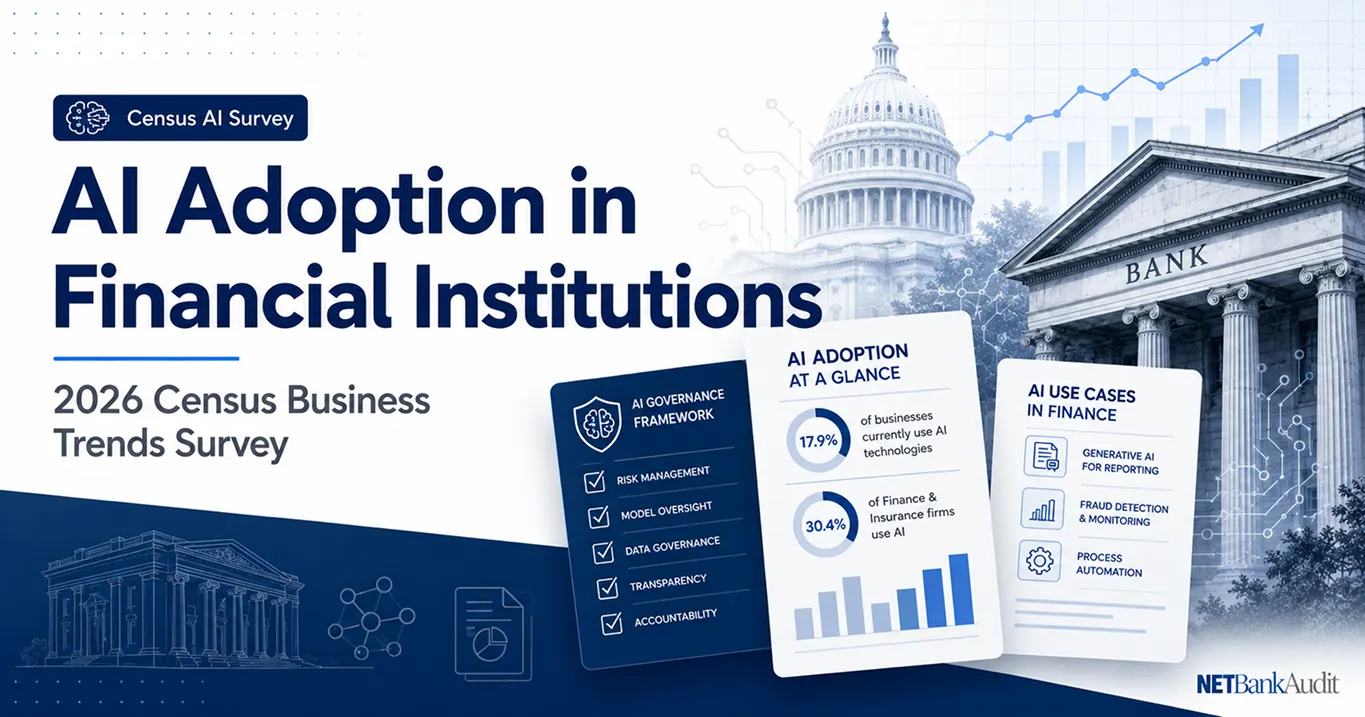
- Current firm-level AI use: In the last two weeks, 17.9% of businesses reported using AI in any business function. Another 71.3% said no, and 10.8% said they did not know.
- Employee AI assistance: Over the last six months, 22.6% of businesses reported employees using AI to assist work-related tasks. This figure is higher than current firm-level AI use, but it uses a different time window.
- Employee generative AI use: Over the last six months, 20.8% reported employees using generative AI to assist with work tasks. That includes tools used to create text, images, music, videos, or code.
- Expected near-term AI use: Looking ahead six months, 21.6% of businesses expected to use AI in any business function. Another 22.2% said they did not know, which signals continued uncertainty.
For financial institutions, the “do not know” responses are important. They suggest that some organizations may lack visibility into employee use, vendor-enabled AI, or AI embedded in business software.
Financial Institutions Sit Above the National AI Adoption Average
The workbook’s sector data show sector code 52, finance and insurance, at 30.4% current AI use. That is materially above the national current-use figure of 17.9%.
The same sector shows 34.0% employee AI assistance, 29.6% employee generative AI use, and 34.1% planned AI use. For banks and credit unions, this reinforces that AI is already relevant to peer benchmarking, even if use cases vary widely.
Firm size also matters. Businesses with 250 or more employees reported 30.6% current AI use, while the smallest groups under 20 employees ranged from 17.0% to 17.6%.
The article highlighted 30 percent of larger firms, those with at least 250 employees, using AI compared with 17 percent among firms with fewer than 20 employees. The workbook exact estimate for 250 or more employees is 30.6%.
Function-level use points to governance hotspots
Across all companies, the highest current AI-use functions were sales and marketing at 14.3%, strategy and business development at 12.4%, information technology at 11.4%, and research and development at 11.2%.
Legal and compliance showed 7.1% current AI use across all companies. Among companies planning AI use during the next six months, 32.3% planned use in legal and compliance, but that planned-use figure has a different scope than the current-use figure.
This is a key control point. A financial institution should not assume AI risk sits only in technology. The Census categories show activity across customer-facing, administrative, strategic, IT, finance, and compliance-related functions.
Generative AI Is Mostly Knowledge-Work Assistance
The generative AI findings are especially relevant to compliance teams because many leading tasks involve documents, information gathering, summarization, and communications. These are areas where accuracy, privacy, retention, and review expectations can matter. The data also challenge the idea that work-related generative AI is mainly coding.
- Among companies where employees used generative AI, 85.4% used it for writing or editing documents, emails, or communications, making this the leading reported task.
- Searching for information or technical help was reported by 49.9% of companies where employees used generative AI.
- Interpreting, analyzing, translating, or summarizing documents was reported by 44.6%.
- Information processing, paperwork, or filing was reported by 34.7%.
- Developing or researching new projects, processes, or products was reported by 30.0%.
- Software coding or debugging was reported by 12.7%, far below writing, search, summarization, and paperwork-related tasks.
For financial institutions, these findings support a practical first step: identify where employees may be using generative AI to draft, summarize, interpret, or process information. That inventory should be broader than software development.
Employment Findings Do Not Support Overstated Replacement Claims
The Census supplement does not show broad employment displacement among AI-using companies. Among those companies, 95.7% reported no change in total employment during the last six months due to AI.

Only 2.3% reported increased employment, and 2.0% reported decreased employment. That does not mean AI has no operational impact. It means the employment effect reported in this survey was limited at the total-employment level.
The task data gives more detail. Among AI-using companies, 43.7% said AI supplemented or enhanced a task performed by an employee, while 10.1% said AI performed a task previously done by an employee.
When businesses reported AI performing tasks previously done by employees, most described the number of tasks as small. The workbook shows 70.9% reported a small number, 22.0% a moderate number, and 7.1% a large number.
For compliance professionals, the practical lesson is that job counts may not reveal AI-driven process change. Review procedures, workflow ownership, approval points, and data handling may change even when headcount does not.
Nonadoption Data Shows Practical Barriers, Not Just Resistance
The reasons for not planning AI use are useful for policy and training discussions. They show that nonadoption is often tied to perceived fit, knowledge gaps, and privacy or security concerns. They do not support a simple claim that cost or regulation is the main barrier.
- Perceived lack of fit: Among businesses not planning to use AI in the next six months, 61.6% said AI is not applicable to the business. This was the largest stated reason by a wide margin.
- Knowledge gaps: Lack of knowledge on AI capabilities was reported by 22.0%. For a financial institution, this supports role-specific training before broad adoption decisions.
- Privacy and security concerns: Privacy and security concerns were cited by 20.7%. This finding is directly relevant to banks evaluating AI tools, employee use, and vendor-enabled AI features.
- Other barriers were lower: Concerns about bias were reported by 8.6%, too expensive by 6.9%, lack of required data by 5.1%, and laws and regulations preventing or restricting use by 2.8%.
The compliance implication is not that privacy, security, bias, or legal limits are minor issues. Rather, the survey shows how businesses ranked their reasons for near-term nonuse within this supplement.
Practical AI Governance Lessons for Banks and Credit Unions
The Census supplement gives compliance teams a disciplined way to frame AI adoption. It separates current use, employee assistance, generative AI, planned use, tasks, employment effects, and reasons for nonadoption. That separation can improve scoping before an audit or risk assessment.
Separate AI categories in internal inventories
Do not collapse firm-level AI use, employee AI assistance, and generative AI use into one line item. The Census data shows these categories have different percentages and different measurement windows.
Start with high-likelihood functions
Sales and marketing, strategy and business development, IT, and research and development led current function-level use. For financial institutions, these areas deserve early questions during AI inventory work.
Include legal, compliance, and finance workflows
Legal and compliance current use was lower than several other functions, but planned use among AI-planning companies was notable. Finance and accounting also appeared in both current and planned function-use data.
Review employee drafting and summarization practices
Generative AI use was heavily concentrated in writing, editing, search, summarization, paperwork, and research. Those activities can affect how information is created, reviewed, stored, and relied upon.
Do not rely only on workforce impact reviews
Most AI-using companies reported no total employment change. A stronger review should examine process changes, task support, vendor involvement, data practices, training, and workflow updates.
What the AI Adoption Data Means Before Your Next Audit
The April 2026 data supports a practical audit stance: AI adoption is real, but uneven. A financial institution should neither assume every department is using AI nor assume AI is absent because there is no formal enterprise rollout.
The workbook also shows that many AI-using companies made no changes to use AI. Among AI users, 64.3% reported no changes, while 15.4% developed new workflows and 15.0% trained current staff.
That finding is important for control testing. Lightweight adoption can still create policy, access, vendor, data, and review questions, especially when employees are using AI to assist work tasks without major organizational changes.
The BTOS About materials also note that estimates are subject to sampling error and nonsampling error, including coverage error, measurement error, processing error, and possible nonresponse bias. Audit teams should use the data for scoping and benchmarking, not as proof of conditions inside their own institution.
How NETBankAudit Can Help Financial Institutions Assess AI Adoption Risk
AI adoption in business is moving faster than many governance processes. The Census data shows why financial institutions need clear inventories, scoped reviews, and practical questions about employee use, generative AI tasks, business functions, workflow changes, and privacy or security concerns.
NETBankAudit helps financial institutions translate technology trends into audit and compliance action. If your institution is evaluating AI use, employee generative AI activity, vendor-enabled tools, or related control gaps, contact NETBankAudit to discuss how our team can support your next review.
%201%20(1).svg)
%201.svg)

.svg)



%201.webp)



.webp)
%20(1).webp)

.webp)

.webp)
.webp)
.png)
.webp)

.webp)




.webp)


.webp)

%201.webp)
.webp)
%20(3).webp)


.webp)


%20Works.webp)

.webp)


.webp)
%20(1).webp)

.webp)


.webp)
.webp)

.webp)
.webp)
.webp)
.webp)
.webp)
.webp)
%201.svg)