.avif)
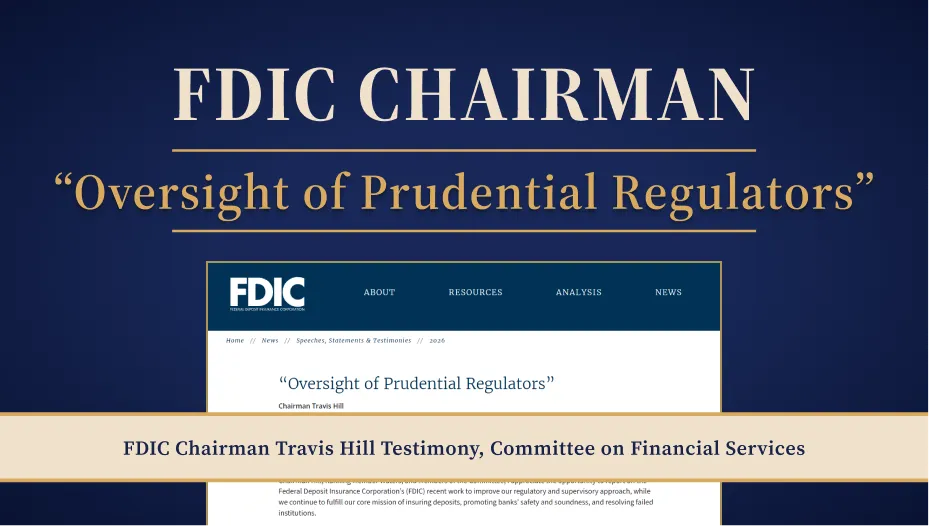
On March 11, 2026, FDIC Chairman Travis Hill delivered remarks at the ABA Washington Summit outlining the agency’s ongoing and planned reforms to its regulatory toolkit. Hill described these efforts as aimed at bolstering economic growth, fostering innovation, promoting stability, and making regulation and supervision more fit for purpose. His speech addressed supervision, capital, liquidity, BSA/AML, digital assets, and resolution policy. This article summarizes the main points from Hill’s remarks and offers practical considerations for compliance professionals at financial institutions.
NETBankAudit experts have over 25 years of experience in FDIC compliance audits and regulatory change management. If you have any questions after reading this guide, please reach out to our team.

Supervision Reform: Focusing on What Matters Most
Chairman Hill described a series of supervision reforms that the FDIC is pursuing, many in coordination with the OCC. Hill said the agency’s direction is to make supervision more fit for purpose and focused on material financial risks and actual violations of law. He indicated that these efforts are intended to ensure that supervisory resources are directed to the most significant issues and that regulation supports, rather than hinders, economic growth and innovation.
Clarifying Supervisory Criticisms and MRAs
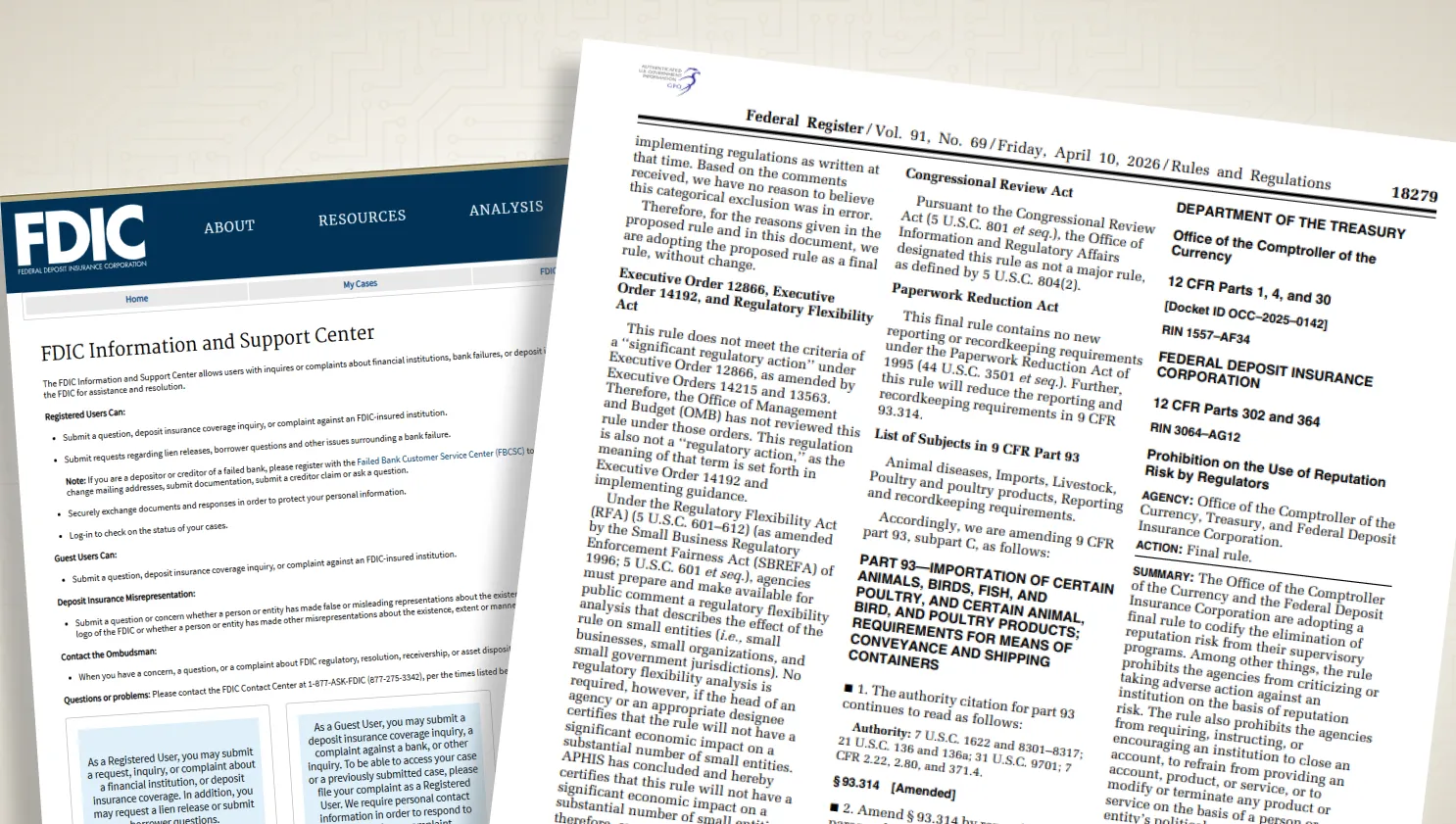
The FDIC, together with the OCC, has issued a joint proposal to define “unsafe or unsound practices” and “matters requiring attention” (MRAs). Hill explained that this proposal is intended to provide greater clarity about the types of issues that warrant formal supervisory attention. Separately, he noted that the FDIC is refocusing examinations on material risks and violations of law, rather than minor process deviations.
CAMELS Reform and Examiner Training
Hill said CAMELS ratings are under review and examiner training and manuals are being updated to better reflect actual risk and performance.
Consumer Compliance: Planned Changes to Reduce Burden
Hill outlined several areas where the FDIC is considering or planning changes to consumer compliance supervision. These include:
- Reducing exam frequency for small banks with strong compliance records.
- Eliminating disparate impact analysis from fair lending reviews, focusing instead on actual violations of law.
- Limiting criticisms to clear legal violations, not process errors or policy disagreements.
- Narrowing pre-exam scoping and focusing more on products material to smaller banks.
- Exploring guardrails on examiner visitations and raising dollar thresholds for serious violations.
- Ending retroactive restitution tied to later policy changes.
Hill emphasized that these changes are intended to make consumer compliance exams less burdensome and more predictable, allowing institutions to focus resources on areas of real risk.
Capital and Liquidity: Targeted Reforms and Proposals
Chairman Hill discussed several ongoing and upcoming changes to capital and liquidity requirements, with an emphasis on tailoring rules to actual risk and reducing unnecessary complexity.
Capital Reform: eSLR, CBLR, and Basel Implementation
The FDIC is reviewing the enhanced Supplementary Leverage Ratio (eSLR) and the Community Bank Leverage Ratio (CBLR) to ensure they are appropriately calibrated. Hill said that two new risk-based capital proposals are expected, including adjustments for Basel implementation and a “single stack” approach to reduce duplicative requirements. The agency is also considering removing gold-plating from mortgage lending and retail lending risk weights, among other areas, in the Basel-related proposal.
Liquidity Reform: LCR and Federal Reserve Borrowing Capacity
Liquidity requirements are also under review. Hill indicated that the FDIC is considering changes to the Liquidity Coverage Ratio (LCR) and exploring ways to recognize the borrowing capacity of banks at the Federal Reserve. These reforms are intended to ensure that liquidity rules reflect actual funding risks and do not unduly constrain well-managed institutions.
BSA/AML Modernization: Risk-Based, Innovation-Friendly Approach
Hill’s remarks included a critique of the 2024 BSA/AML Program Rule proposal, arguing that it would increase box-checking and reduce effectiveness. He said the FDIC supports a more risk-based approach to AML compliance, with resources focused on higher-risk areas and openness to the use of innovative technologies, including artificial intelligence, for suspicious activity monitoring and customer identification, provided that effective controls are maintained.
Digital Assets and Deposit Insurance: Stablecoins and Tokenized Deposits
The FDIC is preparing a proposal to clarify the treatment of payment stablecoins under the GENIUS Act. Hill stated that under this framework, payment stablecoins are not “subject to deposit insurance,” and treating holders as insured depositors on a pass-through basis appears inconsistent with that approach. This distinction is important for institutions considering involvement in digital asset markets.
Tokenized Deposits: Statutory Treatment
Hill stated that if a product meets the statutory definition of a deposit, it remains a deposit regardless of the technology used. The FDIC plans to provide clarification and seek comment on tokenized deposits and pass-through questions.
Resolution Readiness: Shelf Charters and Private Investor Policy
Hill addressed the FDIC’s plans to rescind the 2009 private investor policy and to explore emergency nonbank shelf-charter mechanisms. These steps are intended to address gaps in failed-bank resolution readiness and to remove barriers to nonbank participation in failed-bank bids, including exploring a path for rapid nonbank acquisition in a failure scenario.
Practical Takeaways for Compliance Professionals
While Hill’s remarks were policy-focused, they suggest several areas where compliance teams may want to review their programs and prepare for a more targeted, risk-sensitive supervisory environment. NETBankAudit recommends the following practical steps:
- Monitor FDIC and OCC proposals on MRAs and unsafe or unsound practices, and be prepared to adjust policies as definitions are clarified.
- Stay informed about CAMELS review developments and examiner training updates that may affect examination focus.
- Assess consumer compliance programs in light of potential changes to exam frequency, violation thresholds, and the focus on legal violations.
- Evaluate capital and liquidity planning in anticipation of upcoming proposals and possible changes to eSLR, CBLR, and LCR.
- Modernize BSA/AML programs to prioritize risk-based controls and support innovation, including responsible use of AI where appropriate.
- Track developments in digital asset regulation, especially regarding stablecoins and tokenized deposits.
- Review contingency planning in light of possible changes to resolution policy and shelf charter mechanisms.
NETBankAudit specializes in helping financial institutions navigate regulatory changes and challenges, prepare for examinations, and strengthen compliance programs. To learn how our audit and advisory services can support your institution’s success, contact NETBankAudit today.
%201%20(1).svg)
%201.svg)

.svg)





%201.webp)


.webp)
%20(1).webp)

.webp)

.webp)
.webp)
.png)
.webp)

.webp)




.webp)


.webp)

%201.webp)
.webp)
%20(3).webp)


.webp)


%20Works.webp)


.webp)


.webp)
%20(1).webp)

.webp)


.webp)
.webp)

.webp)
.webp)
.webp)
.webp)
.webp)
.webp)
%201.svg)