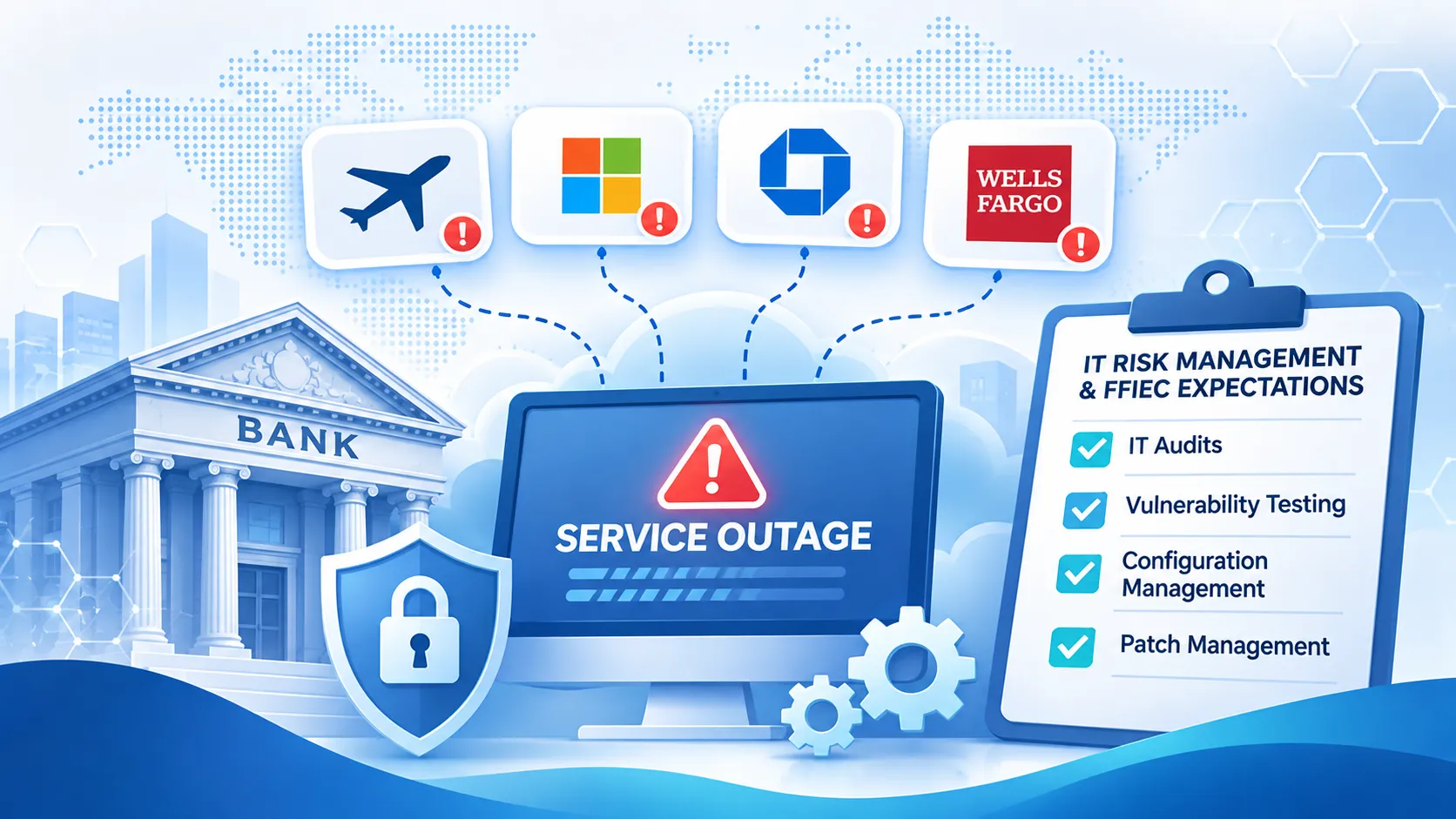
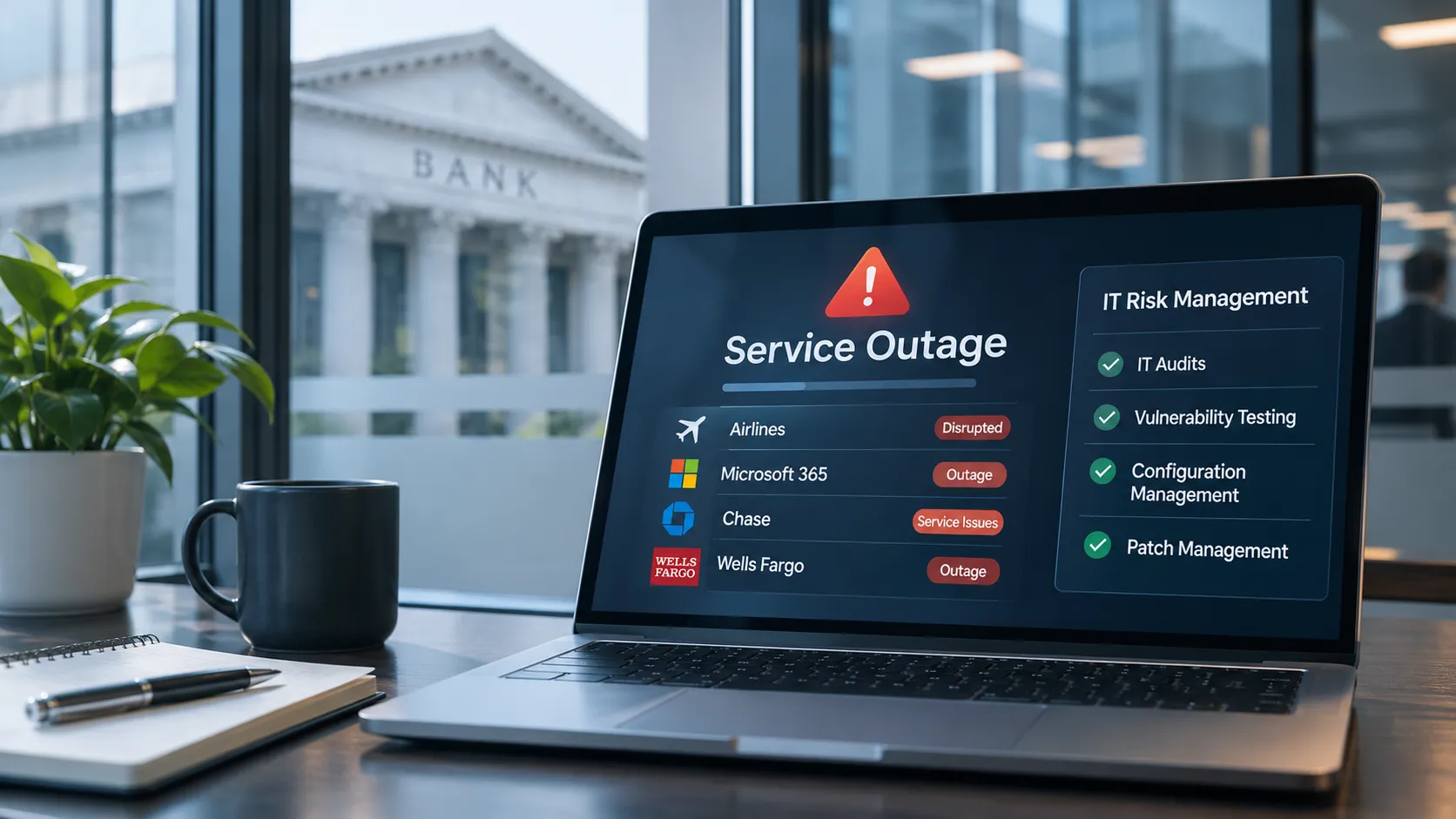
Recent technology disruptions affecting the airline industry, Microsoft, JPMorgan Chase and Wells Fargo demonstrate just how dependent today's economy has become on reliable technology infrastructure.
In November 2026, a series of disruptions affected critical services across several industries:
- Airline and aviation disruptions: Technology problems affecting airline operations, together with a nationwide Federal Aviation Administration (FAA) ground stop, disrupted air travel and flight schedules.
- Microsoft outage: A widespread Microsoft 365 disruption affected Outlook, Teams and other enterprise services, interrupting communications and business operations.
- JPMorgan Chase outage: A software defect involving on-premises hardware systems caused transaction processing delays and affected customers attempting to access banking services.
- Wells Fargo outage: Customers reported difficulties accessing online banking, checking account balances and conducting transactions.
These incidents occurred within days of one another, highlighting the operational risks associated with technology dependencies, complex infrastructure, software defects and interconnected systems.
Importantly, there is no established evidence that these incidents shared a common cause or resulted from a coordinated cyberattack. The Chase incident was attributed to a software issue, and Microsoft reported no indication of a cyberattack associated with its disruption.
Nevertheless, the regulatory implications for financial institutions are significant.
For banks and credit unions, these incidents reinforce the importance of maintaining effective IT risk management programs, conducting independent IT audits, performing vulnerability assessments, reviewing system configurations and maintaining disciplined patch management practices.
The question financial institution management should be asking is not whether an outage could happen to their institution. It is whether their existing controls would prevent, detect, contain and recover from one.
What Financial Institutions Should Learn from These Outages
Although the affected organizations operate in different industries, the incidents illustrate several technology risk management concerns that are directly relevant to financial institutions.
1. Technology Configuration Management Is Critical
Technology configurations frequently change as organizations implement software updates, modify network settings, introduce new security tools and adjust infrastructure.
A configuration error or improperly implemented change can have consequences extending well beyond the system being modified.
The July 2024 CrowdStrike incident provides an important historical example. A defective content update to CrowdStrike's Falcon security software caused approximately 8.5 million Windows devices worldwide to experience disruptions. Airlines, financial institutions, healthcare organizations and other businesses were affected.
The incident demonstrated that even security products designed to protect technology infrastructure can introduce significant operational risk when updates and changes are not adequately controlled and tested.
Financial institutions should therefore maintain documented configuration standards and perform independent reviews to determine whether production systems are configured consistently with approved security baselines.
Configuration reviews should include:
- Windows servers and workstations.
- Network infrastructure, including routers, switches and firewalls.
- Microsoft 365 and Azure environments.
- Database platforms and operating systems.
- Endpoint detection and response (EDR) solutions.
- Antivirus and other security software.
- Cloud infrastructure and externally hosted services.
- Privileged access and administrative configurations.
- Critical applications supporting banking operations.
An effective configuration review should identify unauthorized changes, deviations from established baselines, unnecessary services, insecure settings and weaknesses that could affect system availability or security.
2. Vulnerability Testing Must Go Beyond Automated Scanning
Financial institutions frequently rely on automated vulnerability scanning tools to identify security weaknesses.
While these tools are important, simply running vulnerability scans does not establish that an institution has an effective vulnerability management program.
Testing should determine whether:
- All critical infrastructure is included in the vulnerability scanning program.
- Internal and external vulnerability assessments are performed.
- Systems are evaluated using current vulnerability databases.
- Vulnerabilities are prioritized according to risk and business criticality.
- Critical and high-risk vulnerabilities are addressed within established timeframes.
- Exceptions are formally documented and approved.
- Remediation is independently verified.
- Recurring vulnerabilities are escalated to management.
- Third-party and cloud-hosted infrastructure is appropriately addressed.
Institutions should also consider authenticated vulnerability scanning, network penetration testing and testing of externally exposed systems.
An important distinction exists between identifying a vulnerability and demonstrating that it has been appropriately remediated.
Independent audit testing should verify that identified vulnerabilities have been corrected rather than relying exclusively on management representations or vulnerability management reports.
3. Patch Management Must Be Independently Reviewed
The recent outages also reinforce the importance of effective patch and software update management.
Financial institutions must balance two competing risks:
- Delaying security updates can leave systems exposed to known vulnerabilities and exploitation.
- Implementing updates without adequate testing can introduce operational disruptions, compatibility problems or system failures.
The CrowdStrike incident illustrates the second risk.
A mature patch management program should address both security and operational considerations.
An effective program should include:
- Formal patch management policies and procedures.
- Identification of applicable operating system and application updates.
- Risk-based prioritization of patches.
- Testing of patches before production deployment, where appropriate.
- Documented approvals for production changes.
- Defined emergency patching procedures.
- Rollback and recovery procedures.
- Verification that patches were successfully installed.
- Documentation of deferred patches and compensating controls.
- Management reporting regarding outstanding vulnerabilities and patch exceptions.
Auditors should specifically examine whether patch management procedures are consistently followed and whether management can demonstrate that patches are actually installed.
A patch management policy alone is insufficient. The effectiveness of the process must be tested.
What Does the FFIEC Expect from Financial Institutions?
The Federal Financial Institutions Examination Council (FFIEC) provides examination guidance used by federal and state banking regulators when evaluating the technology risk management practices of financial institutions.
The FFIEC IT Examination Handbook, particularly the Architecture, Infrastructure, and Operations (AIO) and Information Security booklets, provides important guidance for evaluating an institution's technology infrastructure, security controls and operational risk management.
The AIO booklet emphasizes enterprise-wide approaches to technology architecture, infrastructure implementation and operational delivery.
It also addresses governance, IT asset management, internal audit, independent reviews, operational controls and third-party relationships.
These are not simply theoretical considerations. They represent areas that examiners evaluate when determining whether management appropriately identifies and manages technology risks.
The FFIEC guidance does not create a specific regulatory requirement to prevent every technology outage. Instead, it establishes an examination framework for evaluating whether management has implemented appropriate controls to manage the risks associated with its technology environment.
FFIEC Examination Focus Areas
Following significant technology disruptions across the financial services industry, financial institutions should anticipate continued examiner interest in the following areas.
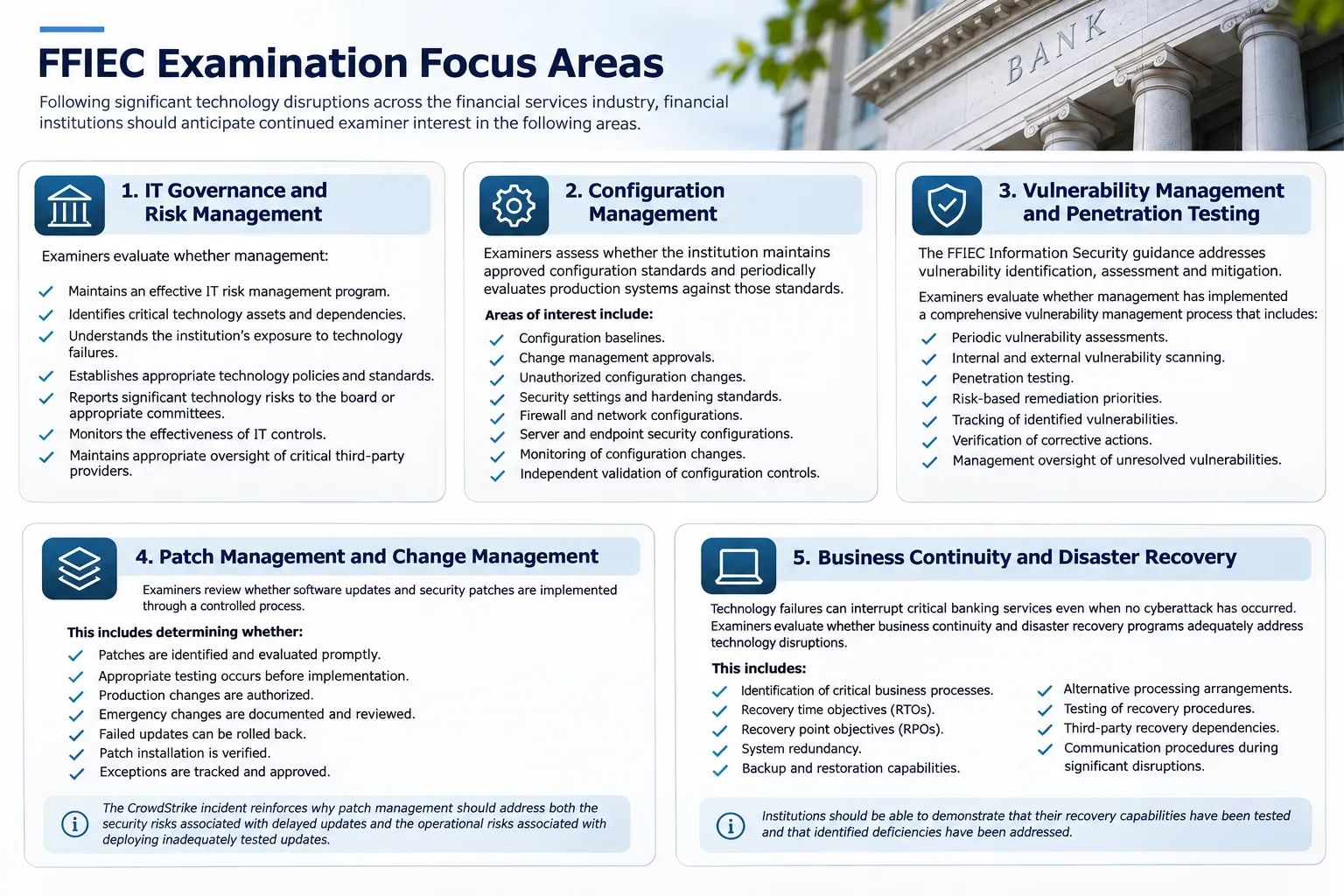
1. IT Governance and Risk Management
Examiners evaluate whether management:
- Maintains an effective IT risk management program.
- Identifies critical technology assets and dependencies.
- Understands the institution's exposure to technology failures.
- Establishes appropriate technology policies and standards.
- Reports significant technology risks to the board or appropriate committees.
- Monitors the effectiveness of IT controls.
- Maintains appropriate oversight of critical third-party providers.
2. Configuration Management
Examiners assess whether the institution maintains approved configuration standards and periodically evaluates production systems against those standards.
Areas of interest include:
- Configuration baselines.
- Change management approvals.
- Unauthorized configuration changes.
- Security settings and hardening standards.
- Firewall and network configurations.
- Server and endpoint security configurations.
- Monitoring of configuration changes.
- Independent validation of configuration controls.
3. Vulnerability Management and Penetration Testing
The FFIEC Information Security guidance addresses vulnerability identification, assessment and mitigation.
Examiners evaluate whether management has implemented a comprehensive vulnerability management process that includes:
- Periodic vulnerability assessments.
- Internal and external vulnerability scanning.
- Penetration testing.
- Risk-based remediation priorities.
- Tracking of identified vulnerabilities.
- Verification of corrective actions.
- Management oversight of unresolved vulnerabilities.
A particularly important consideration is whether the institution's vulnerability assessments cover its entire technology environment, including systems operated by third-party service providers where applicable.
4. Patch Management and Change Management
Examiners review whether software updates and security patches are implemented through a controlled process.
This includes determining whether:
- Patches are identified and evaluated promptly.
- Appropriate testing occurs before implementation.
- Production changes are authorized.
- Emergency changes are documented and reviewed.
- Failed updates can be rolled back.
- Patch installation is verified.
- Exceptions are tracked and approved.
The CrowdStrike incident reinforces why patch management should address both the security risks associated with delayed updates and the operational risks associated with deploying inadequately tested updates.
5. Business Continuity and Disaster Recovery
Technology failures can interrupt critical banking services even when no cyberattack has occurred.
Examiners evaluate whether business continuity and disaster recovery programs adequately address technology disruptions.
This includes:
- Identification of critical business processes.
- Recovery time objectives (RTOs).
- Recovery point objectives (RPOs).
- System redundancy.
- Backup and restoration capabilities.
- Alternative processing arrangements.
- Testing of recovery procedures.
- Third-party recovery dependencies.
- Communication procedures during significant disruptions.
Institutions should be able to demonstrate that their recovery capabilities have been tested and that identified deficiencies have been addressed.
Why Independent IT Audits Are More Important Than Ever
One of the most important lessons from these incidents is that having technology policies and procedures does not necessarily mean that the underlying controls are operating effectively.
Management may believe that configurations are secure, patches are current and vulnerability assessments are being performed. However, without independent testing, there may be little assurance that these controls are functioning as intended.
Independent IT audits provide an opportunity to evaluate the actual effectiveness of technology controls.
NETBankAudit recommends that financial institutions incorporate the following areas into their IT audit programs.
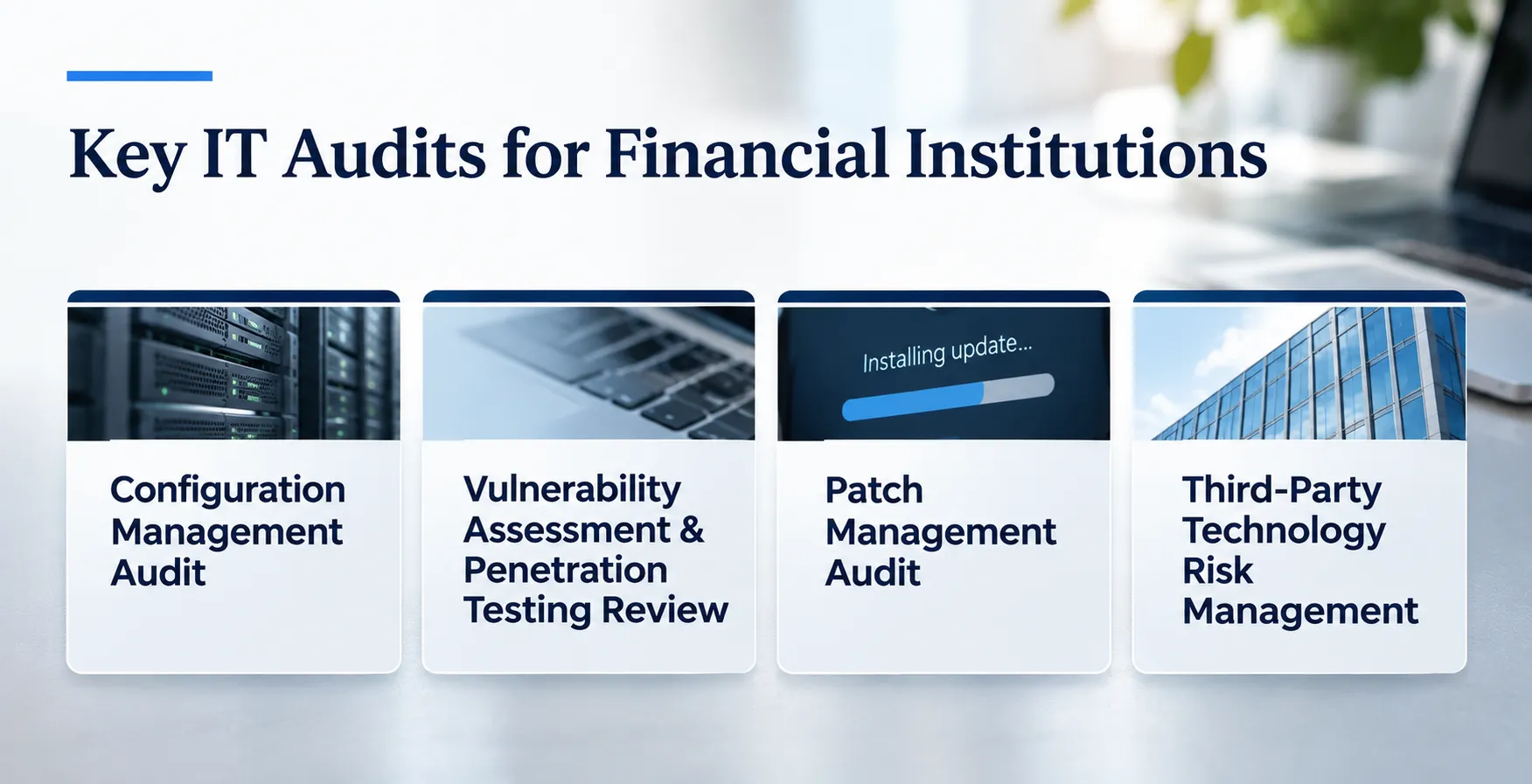
Configuration Management Audit
An independent configuration management audit should evaluate whether production systems comply with approved security configurations.
Testing should include:
- Comparing actual system configurations against approved baselines.
- Reviewing firewall rules and network configurations.
- Evaluating server hardening standards.
- Reviewing privileged access settings.
- Identifying unnecessary services and open ports.
- Examining configuration change logs.
- Reviewing deviations and approved exceptions.
Auditors should obtain direct evidence from the underlying systems whenever possible rather than relying solely on management-generated reports.
Vulnerability Assessment and Penetration Testing Review
An independent review should evaluate the design and effectiveness of the institution's vulnerability management program.
Testing should include:
- Reviewing the institution's vulnerability assessment methodology.
- Evaluating the scope and frequency of vulnerability scans.
- Confirming that critical systems are included.
- Reviewing penetration testing reports.
- Evaluating the prioritization of identified vulnerabilities.
- Testing remediation tracking.
- Verifying that previously identified vulnerabilities have been corrected.
- Reviewing management's acceptance of unresolved risks.
Particular attention should be given to critical and high-risk vulnerabilities that remain unresolved beyond established remediation deadlines.
Patch Management Audit
Patch management should be a recurring component of the institution's IT audit program.
Auditors should independently test servers, workstations, network devices and critical applications to determine whether required security patches have been installed.
Testing should include:
- Comparing installed patch levels against applicable vendor releases.
- Reviewing patch deployment schedules.
- Examining evidence of pre-production testing.
- Reviewing change management approvals.
- Testing emergency patch procedures.
- Evaluating patch deployment failures.
- Reviewing exceptions and compensating controls.
- Confirming that remediation was completed within established timeframes.
Auditors should also evaluate whether management monitors patches that have been deferred because of compatibility or operational concerns.
Third-Party Technology Risk Management
Financial institutions increasingly depend on external technology providers for critical business services.
The Microsoft outage and other industry disruptions demonstrate that third-party technology failures can affect multiple institutions simultaneously.
Financial institutions should evaluate whether their vendor management programs adequately address:
- Critical technology dependencies.
- Vendor business continuity capabilities.
- Incident notification procedures.
- Service availability commitments.
- Independent control assessments and SOC reports.
- Vendor vulnerability management practices.
- Patch management responsibilities.
- Subcontractor dependencies.
- Concentration risk.
- Exit and contingency arrangements.
Receiving a SOC report does not eliminate the institution's responsibility to understand and manage the risks associated with outsourced technology services.
What Should Financial Institutions Do Now?
The recent disruptions provide a timely opportunity for financial institutions to reassess their IT risk management and independent audit programs.
NETBankAudit recommends the following actions:
These activities should be risk-based and appropriately scoped to the institution's size, complexity and technology environment.
Importantly, institutions should not wait until their next regulatory examination to identify weaknesses in these areas.
Preparing for Your Next FFIEC Examination
Technology outages frequently generate increased attention from regulators, particularly when disruptions affect critical banking services or demonstrate weaknesses in operational resilience.
During examinations, financial institutions should be prepared to provide evidence supporting the effectiveness of their technology risk management controls.
Examples include:
- Current ERM and IT/Cyber-related risk assessments.
- Technology asset inventories.
- Approved configuration standards.
- Configuration review results.
- Vulnerability assessment reports.
- Penetration testing reports.
- Vulnerability remediation tracking.
- Patch management policies and reports.
- Change management documentation.
- Business continuity and disaster recovery test results.
- Independent IT audit reports.
- Management responses and corrective action plans.
A recurring examination concern is the difference between having a control documented and demonstrating that the control is consistently operating effectively.
Financial institutions should be able to demonstrate not only that they perform vulnerability assessments, configuration reviews and patch management, but also that identified deficiencies are tracked, remediated and independently validated.
How NETBankAudit Can Help
NETBankAudit provides independent IT audit and technology risk assessment services designed to help financial institutions evaluate their technology controls, identify weaknesses and prepare for regulatory examinations.
Our services can help banks and credit unions evaluate the effectiveness of their IT control environments, with particular emphasis on the areas receiving increased attention following recent technology disruptions.
Our services include:
- IT General Controls Audits: Independent evaluation of technology governance, access controls, change management and IT operations.
- Configuration Management Reviews: Assessment of server, network, firewall and endpoint configurations against established security standards.
- Vulnerability Management Reviews: Evaluation of vulnerability scanning, penetration testing, remediation and risk acceptance practices.
- Patch Management Audits: Independent testing of patch deployment, verification, exception management and change controls.
- Third-Party Risk Management Reviews: Assessment of outsourced technology services and vendor control environments.
- Business Continuity and Disaster Recovery Reviews: Evaluation of technology resilience and recovery capabilities.
- Risk Assessment Facilitation: ERM, Information Security/GLBA, Cybersecurity, Artificial Intelligence (AI), Ransomware, Business Continuity/BIA, Wire Transfer/ACH, RDC, Digital Banking, etc.
- FFIEC Examination Readiness: Independent assessments designed to identify control weaknesses before regulatory examinations.
Our objective is to help financial institutions identify and address technology risks before those weaknesses result in operational disruptions, security incidents or regulatory findings.
Conclusion: Technology Resilience Requires More Than Policies and Procedures
The airline, Microsoft, Chase and Wells Fargo disruptions demonstrate that technology failures can have immediate and far-reaching consequences.
For financial institutions, the lessons extend beyond the individual incidents.
Effective technology risk management requires strong governance, secure configurations, comprehensive vulnerability testing, disciplined patch management, effective change controls and independently validated recovery capabilities.
The FFIEC examination framework places significant emphasis on management's ability to identify, assess and mitigate technology risks. Financial institutions should ensure that their independent IT audit programs adequately address these areas.
Now is the time to evaluate whether your institution's technology controls are actually working, not simply whether the policies and procedures exist.
NETBankAudit can help your institution identify technology control weaknesses, strengthen IT risk management and prepare for regulatory examinations.
Contact NETBankAudit to discuss an independent IT General Controls Audit, Configuration Management Audit, Vulnerability Assessment with Penetration Testing and/or Patch Management Audit.
Frequently Asked Questions
1. What does the FFIEC expect banks to do regarding technology outages?
The FFIEC expects financial institutions to maintain appropriate technology risk management with a sound BIA and RPO/RTOs, operational resilience, business continuity and security controls. Examiners evaluate whether management identifies critical technology risks, implements appropriate controls, conducted regularly scheduled risk-based testing, and maintains effective recovery capabilities.
2. Does the FFIEC require banks to perform vulnerability assessments?
FFIEC examination guidance addresses vulnerability identification, assessment and mitigation. Financial institutions should implement vulnerability management programs that identify weaknesses, prioritize remediation according to risk and monitor corrective actions. Examiners evaluate the effectiveness of these processes.
3. How often should banks perform configuration reviews?
Configuration reviews should be performed annually or more frequently as needed in response to significant technology changes, security events or identified risks. The frequency and scope should be based on the institution's risk profile, technology complexity and applicable security standards.
4. Why should patch management be included in an independent IT audit?
Patch management failures can expose systems to security vulnerabilities, while inadequately tested updates can cause operational disruptions. Independent audits determine whether patches are identified, tested, approved, deployed and verified appropriately.
5. What is the difference between vulnerability scanning and penetration testing?
Vulnerability scanning identifies known weaknesses in systems and applications. Penetration testing goes further by attempting to exploit identified weaknesses to evaluate the potential impact and effectiveness of security controls. Both provide valuable information for managing technology risk.
6. Can a bank receive an IT audit finding for inadequate patch management?
Yes. Weaknesses in patch management can result in examination concerns or audit findings, particularly when critical vulnerabilities remain unresolved, patch deployment is inconsistent, exceptions are not appropriately approved or management cannot demonstrate effective remediation.
NETBankAudit | Independent IT Audit and Technology Risk Management Services
Helping financial institutions strengthen technology controls, manage operational risk and prepare for regulatory examinations.